



The Sacredness of Worship and the Call for Justice: A Methodist Minister’s Reflection on the Minneapolis Church Protest
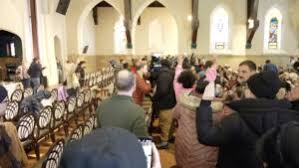
In the heart of Minneapolis, a Southern Baptist church became the epicenter of a cultural and theological firestorm, as anti-ICE protesters disrupted a Sunday morning service to voice their grievances against a pastor’s alleged ties to U.S. Immigration and Customs Enforcement (ICE). The event, which was captured on video and shared widely on social media, sparked a polarizing debate across platforms like X (formerly Twitter) and Threads. Theologian Albert Mohler’s condemnation of the protest further fueled the flames, igniting applause from some and sharp criticism from others.
As a Methodist minister, I find myself drawn into this conversation—not as a partisan voice, but as a shepherd called to reflect on the sacredness of worship, the call for justice, and the tension between these two principles in moments like this.
The Sanctity of Worship: A Sacred Space Under Siege
The church, for centuries, has been a sanctuary—a sacred space where believers gather to worship, pray, and seek solace in the presence of God. It is a place set apart from the chaos of the world, a refuge where the weary can find peace and the broken can find healing. This sanctity is not merely a human tradition; it is a biblical mandate. In Matthew 21:13, Jesus declares, “My house shall be called a house of prayer.”
When protesters stormed Cities Church, they violated this sacred space, disrupting a moment of worship that is central to the life of the Christian community. Albert Mohler’s assertion that such an act is “unspeakably evil” resonates with those who see the church as a place that must remain inviolable. The intrusion raises profound questions: Can the pursuit of justice ever justify the disruption of worship? Does the end—however noble—justify the means?
As a minister, I am compelled to defend the sanctity of worship. Yet, I must also acknowledge that the church is not immune to accountability. Throughout history, the church has been both a refuge for the oppressed and, at times, a complicit institution in systems of injustice. The prophets of the Old Testament did not hesitate to call out the religious leaders of their day, condemning their hypocrisy and their failure to uphold justice. Isaiah 1:17 commands us to “seek justice, correct oppression; bring justice to the fatherless, plead the widow’s cause.”
The Call for Justice: A Prophetic Voice in the Wilderness
The protesters who disrupted the service at Cities Church were not acting out of malice, but out of a deep sense of urgency and a desire to confront what they perceive as injustice. Their actions, while controversial, echo the prophetic tradition of speaking truth to power. Nekima Levy-Armstrong, one of the protesters, declared, “This cannot be a house of God while harboring someone directing ICE agents to wreak havoc on our community.” Her words challenge the church to examine its role in the broader social and political landscape.
The criticism leveled at Mohler on platforms like Threads underscores the tension between the church’s call to be a sanctuary and its responsibility to engage with the world’s injustices. One commenter wrote, “If you, as a Christian leader, have more of an issue with a service being interrupted than that the pastor is a part of a state-sponsored movement to terrorize and abuse immigrants, you have completely and totally missed the point of Jesus.” This perspective forces us to wrestle with the question: What does it mean to be the hands and feet of Christ in a world rife with suffering and inequality?
As a Methodist minister, I am reminded of John Wesley’s call to “spread scriptural holiness throughout the land.” For Wesley, holiness was not confined to personal piety but extended to social action. The church must be a voice for the voiceless, a defender of the oppressed, and a beacon of hope in a dark world. Yet, this mission must be pursued in a way that honors the sacredness of worship and respects the dignity of all people.
Balancing Worship and Justice: A Delicate Dance
The tension between worship and justice is not new. Throughout history, the church has grappled with its dual calling to be a place of sanctuary and a force for social change. The Civil Rights Movement of the 1960s provides a poignant example. Churches served as both sacred spaces for worship and strategic hubs for organizing protests against racial injustice. Leaders like Dr. Martin Luther King Jr. understood that the pursuit of justice must be rooted in the spiritual disciplines of prayer, worship, and community.
In the case of the Minneapolis protest, both sides raise valid concerns. Mohler’s defense of the church as a sacred space is a reminder of the importance of preserving the sanctity of worship. At the same time, the protesters’ actions challenge us to consider whether the church is living out its call to be a voice for justice. These perspectives are not mutually exclusive; rather, they invite us into a deeper conversation about what it means to be the church in the 21st century.
A Methodist Minister’s Perspective: Moving Forward with Grace
As I reflect on this incident, I am struck by the need for grace—grace for the protesters, grace for the congregants, and grace for those, like Mohler, who are grappling with the complexities of this moment. The church must be a place where difficult conversations can happen, where differing perspectives can be heard, and where the love of Christ can bridge the divides that so often separate us.
In Romans 12:18, Paul writes, “If possible, so far as it depends on you, live peaceably with all.” This verse challenges us to seek peace, even in the midst of conflict. It does not call us to avoid difficult conversations or to ignore injustice, but to engage with one another in a spirit of humility and love.
Moving forward, the church must ask itself hard questions. Are we truly living out the gospel in a way that reflects the heart of Christ? Are we creating spaces where all people feel welcome, valued, and heard? Are we willing to confront our own complicity in systems of injustice, even when it is uncomfortable?
A Call to Unity
The events at Cities Church and the ensuing debate reveal the deep cultural and political divides that exist within our society. Yet, as Christians, we are called to be peacemakers, bridge-builders, and ambassadors of reconciliation. This does not mean avoiding conflict or glossing over differences; it means engaging with one another in a way that reflects the love and grace of Christ.
As a Methodist minister, I pray that this incident will serve as a catalyst for deeper reflection, greater humility, and a renewed commitment to the gospel. Let us remember that the church is not merely a building or an institution; it is the body of Christ, called to be a light in the darkness and a beacon of hope for a broken world.
Rev. Michael Brennan
Sources:
- Michael Foust, Mohler’s Comments on Minneapolis Church Protest Spark Fierce Online Debate, My Crosswalk, Jan 19, 2026.
- The Holy Bible, New International Version (NIV).
- John Wesley’s Sermons and Teachings on Holiness and Social Action.