



We spend more time thinking about the next notification than eternity—and it’s changing us.
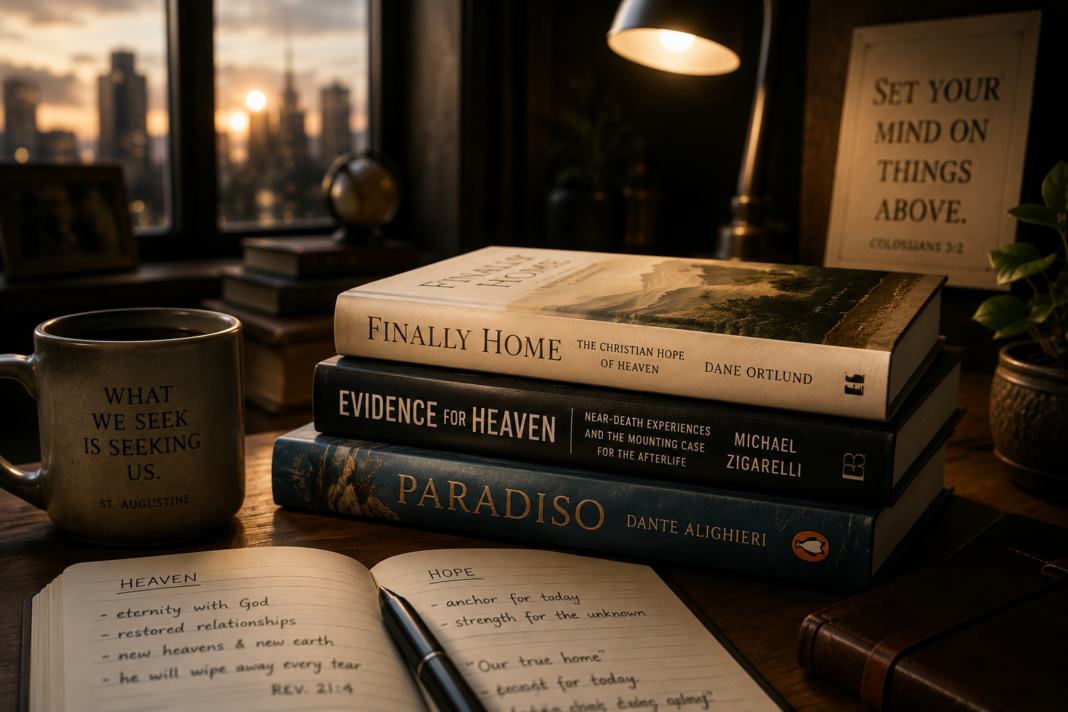
Most of us spend more time thinking about what to watch next than where we are going. These three books — one soaring, one scientific, one seven centuries old — might be the corrective your soul didn’t know it needed.
There’s a peculiar irony in the age of infinite scroll.
We live in a world built on the promise that the next thing will be better than the current thing. One more video. One more post. One more dopamine hit before we stop. And yet, for all this restless forward motion, almost no one is thinking about the one destination that actually awaits every single one of us.
Heaven.
Not the cartoonish version with clouds and harps. Not the Hallmark-card sentimentality. I’m talking about the real thing — the home we were created for, the fulfillment of every longing we’ve ever had but never been able to name.
This spring, three books landed on my desk that all point to that home in profoundly different ways. One is a gift to the church. One is a challenge to the skeptic. One is a 700-year-old masterpiece that will leave you in tears.
Here’s why you should read all three — and why they might just change the way you live today.
Book One: The One You’ll Give to Everyone You Love
Finally Home: The Christian Hope of Heaven — Dane Ortlund (Crossway, October 2026)
Writing about heaven is hard. Too much imagination, and you risk floating away from Scripture. Too much theology, and you risk writing a book that feels more like a textbook than a window into glory.
Dane Ortlund, the author of Gentle and Lowly, threads the needle beautifully in Finally Home. The book is both theologically rich and emotionally stirring. It covers the big questions: What happens after death? What is the resurrection of the body? What does it mean to see God face-to-face? But it does so with the wonder of someone who isn’t just explaining these truths but marveling at them.
Ortlund doesn’t just want you to know about heaven. He wants you to long for it.
What sets this book apart is its ability to surprise. Ortlund opens with a meditation on the brevity of life, grounding the entire discussion in Psalm 90:12: “Teach us to number our days, that we may gain a heart of wisdom.” He explores unexpected questions like which professions might carry over into the new creation and what it means to judge angels.
This is the kind of book you’ll want to share with everyone you know — the grieving friend, the questioning teenager, the person sitting in a hospital waiting room wondering if there’s any hope left. It’s the best modern book on heaven I’ve read.
Book Two: The One for the Skeptic in Your Life
Evidence for Heaven: Near-Death Experiences and the Mounting Case for the Afterlife — Michael Zigarelli (Baker Books, 2026)
If you’ve ever had a friend or family member look at you sideways when you talk about heaven, this is the book for them.
Michael Zigarelli, a Christian researcher and professor, takes the phenomenon of near-death experiences (NDEs) and examines them as evidence for the afterlife. His approach is careful, accessible, and refreshingly level-headed.
Zigarelli builds his argument in three layers:
- The Prevalence of NDEs: These experiences are far more common than most people realize, with millions of documented cases across cultures, religions, and worldviews.
- The Consistency of NDEs: Despite cultural differences, NDEs share strikingly similar features — out-of-body experiences, encounters with overwhelming love and light, and profound life transformations.
- The Christian Implications: Zigarelli argues that these experiences align with the biblical description of heaven.
It’s in this third layer that things get tricky. If people from vastly different backgrounds report similar experiences, how do we reconcile that with the exclusivity of the Christian gospel? Zigarelli acknowledges this tension but leaves some theological questions unanswered.
This book is less about proving heaven and more about opening the door to serious conversations about eternity. Read it with a skeptic in your life or someone who is grieving. Just make sure to bring your Bible along for the ride.
Book Three: The One That Will Make You Cry (In the Best Way)
Paradiso — Dante Alighieri (Penguin Classics, translated by Robin Kirkpatrick)
If you’ve never read Dante’s Divine Comedy, let me make your summer reading list for you.
Paradiso, the final part of Dante’s epic journey through hell, purgatory, and heaven, is the most stunning literary exploration of eternity ever written. It’s not a theological treatise or an argument for the afterlife. It’s a poem — an attempt to describe the indescribable through the beauty of language.
Dante takes us through the spheres of heaven, where he encounters saints, angels, and ultimately God himself. The climax of the poem is his vision of God as pure light and love, so overwhelming that language itself breaks down:
“Here my powers rest from their high fantasy.”
The final lines — “the Love that moves the sun and the other stars” — are, quite simply, perfect.
Reading Paradiso isn’t just an intellectual exercise. It’s an act of worship. It will stretch your imagination and leave you longing for the day when faith becomes sight.
Why These Books Matter Now
Here’s the thread that ties these books together: they remind us that the scroll will end.
We live in a culture that has trained us to exist in the eternal now — never looking beyond the next notification, the next episode, the next distraction. Social media isn’t just a tool. It’s a formation device, shaping us into people who can’t think past the moment.
But the Christian life demands a longer view. Eternity changes everything. As C.S. Lewis wrote, “If you read history, you will find that the Christians who did most for the present world were just those who thought most of the next.”
Ortlund gives us the theology of heaven.
Zigarelli gives us the evidence for it.
Dante gives us the imagination to long for it.
Together, these books remind us that our restless scrolling isn’t just a bad habit. It’s a spiritual symptom. The infinite scroll is a counterfeit of the infinite. It promises that the next thing will satisfy us, but it never does.
The Gospel offers something better: a love that doesn’t end when the scroll does.
That’s worth thinking about.
Faith Signal | Saturday, May 9, 2026
Books referenced: Finally Home by Dane Ortlund (Crossway, October 2026) · Evidence for Heaven by Michael Zigarelli (Baker Books, 2026) · Paradiso by Dante Alighieri, trans. Robin Kirkpatrick (Penguin Classics)