


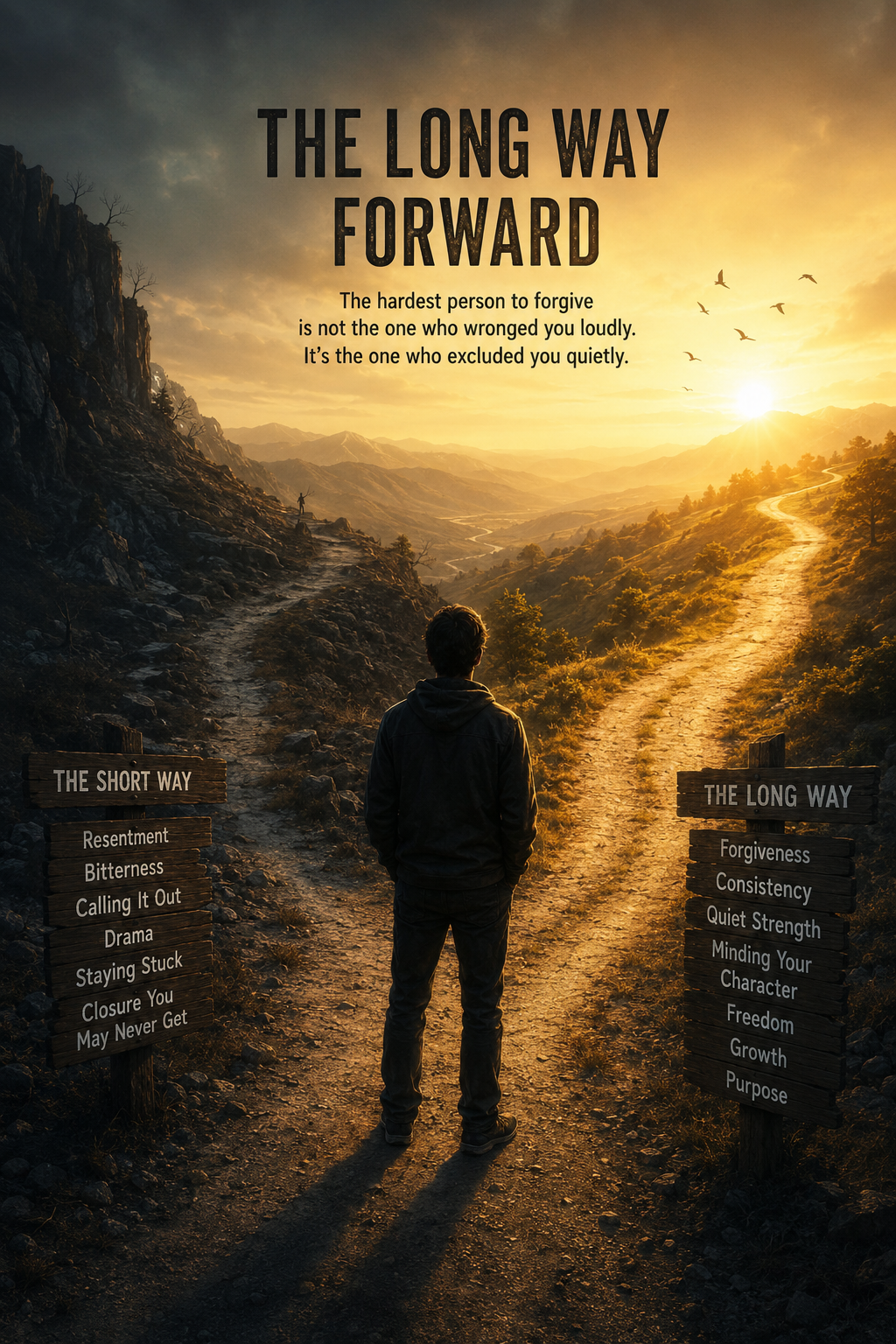

And somehow the quiet distance hurts worse than the loud betrayal ever did
The hardest person to forgive is not the one who wronged you loudly.
It’s the one who excluded you quietly.
The loud wrong gives you something to point to — a moment, a word, an action that crossed a clear line. You can name it. You can bring it up. You can say, “This is what happened. This is why it hurt.” And in the naming, there’s at least the dignity of being understood.
But the quiet exclusion?
The quiet exclusion gives you nothing to hold.
It’s just a lunch that didn’t happen. A text that didn’t come. A conversation that stayed shallow when it used to go deep. The slow, subtle withdrawal of someone who may not even realize they’re doing it — or worse, who knows exactly what they’re doing and has decided that you’re no longer worth the effort.
And there you are. Standing in the gap between what the relationship was and what it is now. Holding the weight of an injury you can’t even fully describe without sounding like the problem.
Because here’s the trap of the quiet exclusion:
If you say something, you look needy.
If you call it out, you look dramatic.
If you name the distance, you become the one who made it a thing.
And suddenly, the person who withdrew gets to be the calm, reasonable one while you’re left holding the bag of your own hurt, wondering if maybe you are too much.
So you stay quiet. You absorb it. You keep showing up with the same consistency, the same generosity, the same “we are” energy that you’ve always brought.
And you carry the weight of the forgiveness alone — in private, on a Saturday night, staring at the ceiling, trying to convince yourself that you can keep doing this without becoming someone smaller than who you are.
This is the long way forward.
And it’s the only way that leads anywhere worth going.
The Temptation to Call It Out
Let’s not pretend this doesn’t feel like an option.
Because it does.
There’s a version of this where you call it out. Where you say, “Hey, I’ve noticed something. The canceled plans, the surface-level conversations, the way you’ve been distant lately — what’s going on?”
And part of you wants to do that.
Not because you’re trying to start something. Not because you’re petty. But because you’re a person with a whole heart who has been investing in something real, and the silence is starting to feel like a rejection you didn’t sign up for.
That desire to call it out? It’s not wrong.
It’s the natural response to the ache of being invisible to someone you’ve chosen to see.
But here’s the problem:
Calling it out doesn’t fix the story.
It hands it over.
Because the moment you make the distance dramatic, you become the headline. You’re suddenly the one who “needed too much,” who “made it weird,” who “couldn’t just let it go.”
And the real issue — the quiet exclusion, the one-sided investment, the withdrawal — gets buried under the optics of your reaction to it.
You don’t lose because you’re wrong.
You lose because you let the pain make the decision.
What Forgiveness Really Is
Matthew 18:21-22 — “Then Peter came to Jesus and asked, ‘Lord, how many times shall I forgive my brother or sister who sins against me? Up to seven times?’ Jesus answered, ‘I tell you, not seven times, but seventy-seven times.’”
Peter thought he was being generous. Seven times? That’s a lot of forgiving.
Jesus said seventy-seven.
Not because He was giving Peter a math problem, but because Peter’s entire framework was wrong. He was thinking about forgiveness as something you measure, something that has a limit, something you give until you’ve given enough.
But real forgiveness doesn’t count.
And here’s the part nobody talks about:
Real forgiveness doesn’t always come with closure.
Peter’s question assumes the other person knows they’ve done something wrong. It assumes they’ve apologized, or at least acknowledged the hurt.
But what about the quiet exclusion?
What about the person who has no idea they’ve hurt you? Or worse, who knows and doesn’t care?
Forgiveness still applies.
Not because they deserve it. Not because they’ve asked for it. But because you deserve to be free of the weight of carrying it.
Forgiveness is not about letting them off the hook.
It’s about refusing to let their actions shrink your heart.
What the Long Way Forward Looks Like
It looks like showing up on Monday as the same person you were last Monday.
Not angry. Not cold. Not performing normalcy or pretending nothing happened.
Just — yourself.
The man who says “we are” and means it. The man who writes the truest thing he knows how to write and sends it, no matter what comes back. The man who refuses to let the silence make him smaller.
You don’t give them the same access they used to have. Not out of spite, but out of wisdom. The access you gave was based on mutuality, and if the mutuality isn’t there right now, you recalibrate. Quietly. Without announcement. Without drama.
You don’t need to call them out.
Your consistency is the call.
Your steadiness is the statement.
Your refusal to shrink is the loudest sermon you’ll ever preach.
Joseph’s Long Way Forward
Joseph could have taken the short way.
He had every right to. His brothers sold him into slavery, left him for dead, and let their father mourn a son they knew wasn’t gone.
When those same brothers stood before him years later, desperate and unaware of who he was, Joseph could have settled the score. He had the power, the position, and the receipts.
Instead, he wept.
Genesis 45:5 — “And now, do not be distressed and do not be angry with yourselves for selling me here, because it was to save lives that God sent me ahead of you.”
Joseph had reframed the story.
Not because the betrayal didn’t hurt. Not because the years in prison weren’t long. But because he had walked the long way forward and discovered something the short way could never have given him.
The short way — the calling out, the vengeance, the bitterness — would have ended the story in Egypt with a grudge.
The long way forward ended the story with restoration.
The long way is not the consolation prize.
It’s the only road that leads to the kind of life you’re actually hoping for.
☕✝️🔥 The long way forward is hard. But it’s where God does His best work.