


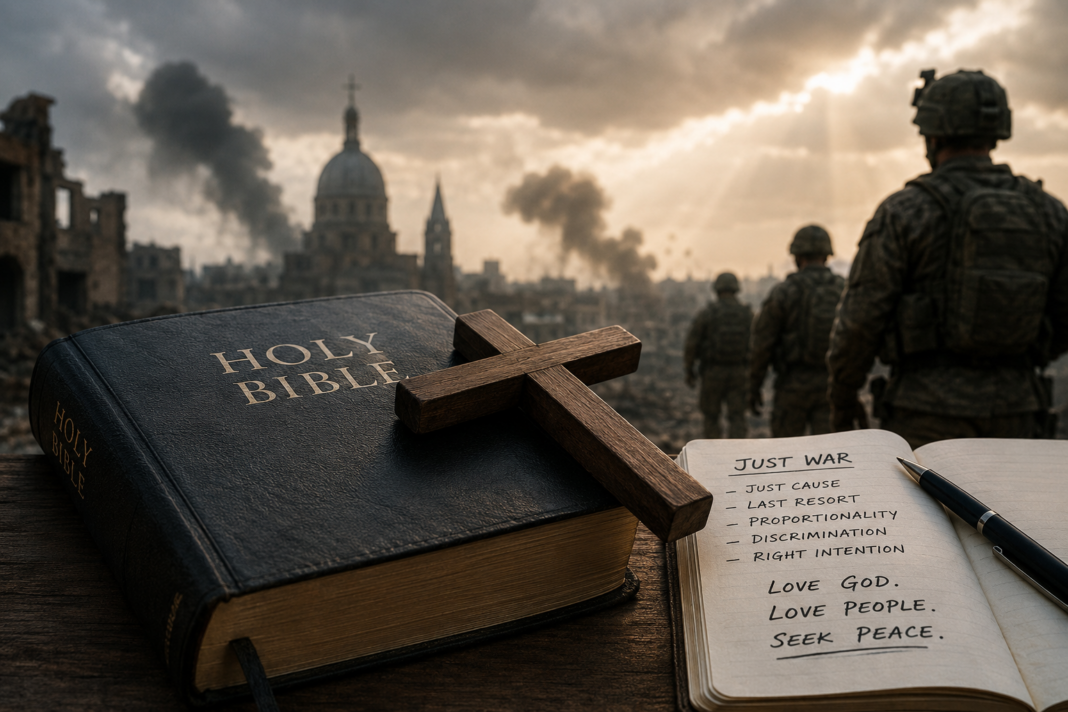

May 16, 2026 — As the United States finds itself embroiled in yet another conflict in the Middle East—this time with Iran—Christians are once again grappling with the ethical complexities of war. The concept of just war theory, a framework deeply rooted in Christian moral reasoning, has taken center stage in public discourse. While some see it as a gift to guide moral decisions in times of conflict, others argue that it highlights the moral and spiritual deficiencies of contemporary culture.
The debates surrounding just war theory are not new. They have been a part of Christian ethical discussions for centuries, dating back to St. Augustine in the fourth century. Yet, as we revisit these principles in light of the current conflict, it becomes clear that the tradition’s original emphasis on virtue and character has been overshadowed by a focus on rules and procedures.
The Purpose of Just War Theory
At its core, the just war tradition seeks to reconcile the harsh realities of war with the Christian call to love and justice. It provides criteria for evaluating whether a war can be morally justified, including:
- Just Cause: Is the war being fought for a morally sound reason?
- Last Resort: Have all other options for resolving the conflict been exhausted?
- Proportionality: Will the benefits of going to war outweigh the harm it will cause?
- Discrimination: Are non-combatants and civilians being protected from harm?
However, as Myles Werntz, a theologian and scholar at Abilene Christian University, points out, the original intent of just war theory was not merely to regulate warfare. It was to shape the moral character of those who wage it. Augustine, one of the earliest proponents of the tradition, emphasized the importance of being a peacemaker even in the act of fighting. He wrote, “When you are arming for battle, think first that even your bodily strength is a gift of God… Be a peacemaker, then, even by fighting, so that by your victory you might bring those whom you defeat to the advantages of defeat.”
^^ ,
A Tradition Lost in Translation
Over the centuries, the focus of just war theory shifted from the virtues of the warrior to the conditions of war itself. By the time Hugo Grotius published his seminal work “The Rights of War and Peace” in 1625, the emphasis was no longer on the moral character of the participants but on the rules governing warfare as an event. This shift was further solidified in the 20th century, when the principles of just war were codified in international treaties like the Geneva Conventions.
While these developments brought much-needed attention to the humane treatment of non-combatants and prisoners of war, they also distanced the tradition from its Christian roots. The original concern for the moral formation of individuals was replaced by a focus on compliance with external rules. In the process, the language of virtue—central to the Bible’s vision of justice—was largely lost.
^^ ,
A Call to Virtue
For Christians, justice is not merely about following rules or achieving practical outcomes. It is about cultivating a heart that loves what is good, true, and beautiful. The Apostle Paul reminds us that God’s law is meant to be written on our hearts (Romans 2:15), calling us to be people who not only act justly but also desire justice from the depths of our being.
This is the challenge and opportunity of the just war tradition. It calls us to examine not only the morality of war but also the state of our own souls. Are we motivated by a genuine desire for peace, or by a thirst for vengeance? Do we seek justice for its own sake, or only when it serves our interests? These are questions that demand deep reflection and spiritual maturity.
A Path Forward
As the United States navigates its current conflict with Iran, Christians have an opportunity to reclaim the original spirit of the just war tradition. This means going beyond debates about rules and procedures to focus on the deeper question of what it means to be a people of justice and peace.
In a world that often prioritizes efficiency over ethics and rules over righteousness, the just war tradition offers a countercultural reminder that justice begins in the heart. It challenges us to become the kind of people who love mercy, walk humbly with God, and seek peace even in the midst of conflict.
As we pray for peace and discernment in these turbulent times, let us remember that the ultimate goal of justice is not merely the absence of war, but the flourishing of human life in harmony with God’s will.
Sources
- : Christianity Today – Just War Theory Is Supposed to Be Frustrating
- : Christianity Today – Just War Debates Reveal Our Moral Poverty
- : Christianity Today – This War Shows the Weakness in Just War Theory
- : Christianity Today – My Family Resisted Iran’s Regime