



This piece was adapted from CT’s books newsletter. Subscribe here.
Jonathan Turley, Rage and the Republic: The Unfinished Story of the American Revolution (Simon & Schuster, 2026)

Rage and the Republic: The Unfinished Story of the American Revolution
Simon & Schuster
448 pages
George Washington University law professor Jonathan Turley’s latest book is well timed for America’s 250th anniversary. He invites readers to ponder how the colonies’ revolution succeeded while similar attempts (most notably in France) ran aground. How did Americans build a republic while avoiding the dangers of autocratic reign or democratic despotism?
In an in-depth history tour, Turley examines a handful of particulars that made the difference, including the tempering effect of some of America’s more cool-headed framers. Turley contrasts the more moderate James Madison with the fiery Thomas Paine, whose galvanizing writings worked to great effect on both Paris and Philadelphia’s uprisings.
Turley contends that our revolution is ever an unfinished experiment, and one that will be tested anew in the coming age of artificial intelligence. Self-destruction is an ever-looming risk, and the challenge is putting away the bayonets once the revolution has run its course. America has so far been docked in a safe harbor thanks to its constitutional guardrails, but those guardrails are not permanently soldered on.
So will American democracy survive?
Turley is at his best during the history retelling portion of the book, which fortunately is the book’s majority. The book is weaker when he fast-forwards to modern times, and he seems less clear-sighted than when he looks to the past. While he identifies challenges America faces in a coming robotic age, from job displacement driven by AI to increasingly bitter factionalism, he is less eloquent on the remedies to these ills.
To Turley, on the left are the new Jacobins, though not (with perhaps an implicit yet) to such a murderous degree. He notes some faults on the political right, but his primary targets are academics, democratic politicians, and CEOs who undervalue America’s robust constitutional protections. These targets are unsurprising from the conservative academic. But in our particular political age, if populist rage and a desire to throw off constitutional guardrails is a characteristic marking only one side of the aisle, I have yet to learn of it.
Mike Pence, What Conservatives Believe: Rediscovering the Conservative Conscience (Center Street, 2026)
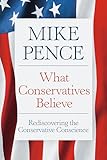
Former vice president Mike Pence came to conservatism in a roundabout way: His parents, Irish Catholics, passed on their Democratic affiliation for the first part of his life. It wasn’t until later, after President Ronald Reagan’s 1980 victory, that he found his way to what would become his political home as a conservative Republican.
A key part of that journey was the writing of conservative giants: William F. Buckley Jr., Russell Kirk, and Edmund Burke tutored him in right-of-center political thought. But reading Barry Goldwater’s The Conscience of a Conservative sealed the deal. Pence wrote his book, What Conservatives Believe, in hopes he will similarly inspire young people—particularly those who don’t remember the Republican Party before the ascent of President Donald Trump and the current populist nature of the party—to embrace what he sees as true conservatism.
Every chapter in What Conservatives Believe lays out his view of core conservative beliefs, from encouragement of free markets to unwavering support for Israel. Peppered throughout are critiques of what he describes as progressive populism that has made inroads on both sides of the aisle.
He has praise for the wins of the “Trump-Pence administration,” including the nominations of conservative judges, actions on income tax cuts, and siding with Israel. But he is also (politely) critical of the embrace of Big Government that he sees as characterizing the second Trump administration more than the first, pointing out its imposition of trillions of dollars of tariffs on both foes and friends, its deliberate thwarting of Congress by ignoring the law against TikTok, and its betrayal of the pro-life wing of the party by appointing a pro-choice secretary of health and human services.
The bookat times reads more like an inspirational campaign speech than the philosophical tours de force that inspired Pence as a young conservative. Readers looking for a distilled version of Pence’s brand of conservatism will get their money’s worth, though casual readers may find it a bit flat. Some points of keenest interest to me were also some of the briefest: His reflections on certifying Joe Biden’s 2024 electoral win, the action that made him a pariah in the Trump world.
“I will always believe that by God’s grace I did my duty and kept my oath to support and defend the constitution,” he writes. But his reflections are over less than a paragraph later, and he has moved on to condemning how the Biden administration would embrace Big Government. It remains to be seen whether these beliefs, like the man, will find a natural political home again.
Edmund Burke, Reflections on the Revolution in France (1790)

Reflections on the Revolution in France (Oxford World’s Classics)
Oxford University Press, USA
326 pages
I first encountered Edmund Burke’s seminal work, Reflections on the Revolution in France, during a political theory class in undergrad. As the 18th-century Irish Catholic statesman and Whig politician is the founder of modern conservatism, it’s worth exploring his writings firsthand.
Burke’s Reflections began after a young Frenchman asked the statesman to weigh in on the revolution, barely a year old, unfolding in his country. From there, the letter morphed into an essay, and from there, into a book. While sympathetic to the discontent in America and insistent that the American colonies ought not to be taxed without representation, Burke was no ally to what was happening in Versailles. It is easy to condemn a revolution gone wrong in hindsight, but Burke was prescient: He foretold unwieldy and violent consequences. He was right.
Reflections is an influential text for conservative political thought, from its concepts of little platoons to favoring local solutions for societal issues. Burke argues that long-held values, traditions, and institutions are key to the stability of the body politic, even when reform—and he would prefer that reform to be gradual, thank you very much—is necessary. When desiring and enacting change, each generation must be aware that its duty is not just to those who are living but also to and for its forebears and its successors. It must both improve and retain the good that has already been built to be passed down. Traditions are the common wisdom that society has stewarded for each successive generation.
Burke’s cautions on France’s revolution can serve as a good check for us liberty-loving Americans, particularly in his warnings of freedom run amok and unmoored from the virtues that have enabled a society to flourish. He writes, “The effect of liberty to individuals is that they may do what they please: we ought to see what it will please them to do, before we risk congratulations, which may be soon turned into complaints.” A prescient warning indeed.
Harvest Prude is national political correspondent at Christianity Today.
The post Conservative Politics in Revolutionary Times appeared first on Christianity Today.