


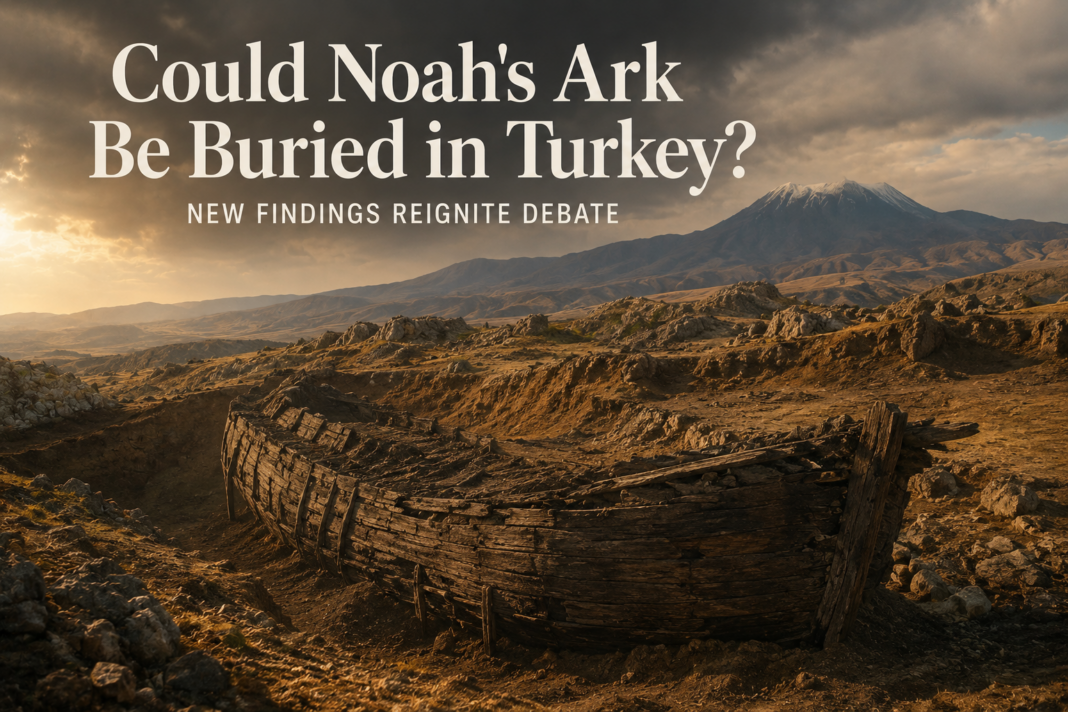

June 7, 2026 — It’s a mystery as old as time itself — has Noah’s Ark been hiding in plain sight all along?
For decades, the Durupinar site in eastern Turkey, a boat-shaped geological formation near Mount Ararat, has been at the center of speculation and study. Some say it’s a natural rock formation. Others insist it’s the remains of the biblical ark that carried Noah, his family, and a pair of every living creature through a global flood.
Now, new findings from researchers at Noah’s Ark Scans, led by Andrew Jones, are breathing fresh life into this ancient debate.
New Evidence from the Durupinar Site
The Durupinar site first captured public attention in the 1950s when it was discovered and quickly linked to the biblical account of Noah’s Ark. Since then, it has been a source of fascination and controversy.
Recent soil analysis conducted by Jones and his team has revealed some startling anomalies. Samples collected in 2024 from the site show significant chemical differences between the “inside” and “outside” of the boat-shaped formation.
Here’s what they found:
- The soil inside the formation contained three times more organic matter than the surrounding area.
- Potassium levels were 38% higher inside the formation, consistent with the presence of wood ash.
- pH levels within the formation were dramatically different — an eightfold variation — suggesting the presence of decayed organic materials such as wood, resin, or even animal remains.
“These findings are statistically staggering,” Jones told Fox News. “They suggest a massive concentration of decayed carbon-based material, which could include wood or other biological substances.”
The Debate That Won’t Quit
As you can imagine, not everyone is convinced.
Skeptics, including many geologists and archaeologists, argue that the Durupinar formation is a natural occurrence. A 1996 study published in the Journal of Geoscience Education concluded that the boat-like shape is the result of erosion and sedimentary processes, not the remnants of a man-made structure.
Critics also point out that the formation lacks definitive evidence of human craftsmanship. Without artifacts or structural components like nails or beams, they argue, it’s impossible to confirm that the site is anything more than an unusual rock formation.
But for proponents of the Noah’s Ark theory, the new chemical and structural anomalies offer a compelling counterpoint. They argue that the concentration of organic material and the patterns identified in the soil cannot be easily explained by natural causes alone.
Technology to the Rescue?
One thing is certain: Technology is changing the game.
In 2019, researchers used 3D ground-penetrating radar (GPR) at the Durupinar site. These scans revealed subsurface features that look an awful lot like corridors and chambers — the kind of internal structure you’d expect to find in a large, man-made vessel.
Now, armed with the 2024 soil analysis, Jones and his team are pushing for even more advanced investigations. They’re advocating for core drilling and further 3D mapping to get a clearer picture of what lies beneath the surface.
“We’ve moved from asking, ‘Does it look like a boat?’ to exploring the internal complexity of the structure,” Jones said.
Faith and Science Collide
The possibility of finding Noah’s Ark has always held a unique allure. It’s not just a scientific puzzle — it’s a question that touches on faith, history, and the origins of humanity.
The Bible describes Mount Ararat as the final resting place of the ark after the great flood. For believers, finding the ark would be a tangible confirmation of a story that has been passed down for millennia.
But even as new evidence emerges, definitive proof remains elusive. And maybe that’s the point.
Faith, by its very nature, doesn’t require proof. It asks us to trust in what we cannot see.
What Does It Mean for Us?
Whether or not the Durupinar site turns out to be the resting place of Noah’s Ark, the story itself holds timeless truths.
It’s a story of obedience in the face of ridicule. A story of faith in the midst of uncertainty. A story of God’s provision and promise.
And maybe that’s what we’re really searching for. Not just a boat buried under layers of rock and soil, but the assurance that God sees us, hears us, and keeps His promises.
We may never know for sure what lies beneath the Durupinar site. But we do know this:
“The Lord does not look at the things people look at. People look at the outward appearance, but the Lord looks at the heart.” — 1 Samuel 16:7
God isn’t impressed by the size of the boat. He’s moved by the faith it took to build it.
What’s Next?
Jones and his team are determined to continue their work at the Durupinar site, using cutting-edge technology to uncover the truth. Whether they find definitive proof of Noah’s Ark or not, their research reminds us of the enduring power of one of humanity’s oldest stories.
And maybe, just maybe, the real discovery isn’t about what’s buried in the ground.
Maybe it’s about what’s buried in our hearts.
“By faith Noah, when warned about things not yet seen, in holy fear built an ark to save his family.” — Hebrews 11:7
Noah didn’t wait for proof. He trusted God. He obeyed.
And that’s the invitation for us today. To trust, to obey, and to believe that God’s promises are as true now as they were then.
Could Noah’s Ark be buried in Turkey? Maybe.
But even if it’s not, the story is still alive. And so is the God who wrote it.
Sources:
- Noah’s Ark Scans – New GPR Scans at Durupinar Site
- Christian Daily – Evidence Remains Inconclusive at Noah’s Ark Site
- Wikipedia – Durupinar Site
- Patterns of Evidence – The Hunt for Noah’s Ark: Durupinar
FaithSignal | Exploring the intersection of faith, discovery, and the mysteries of God’s creation.