
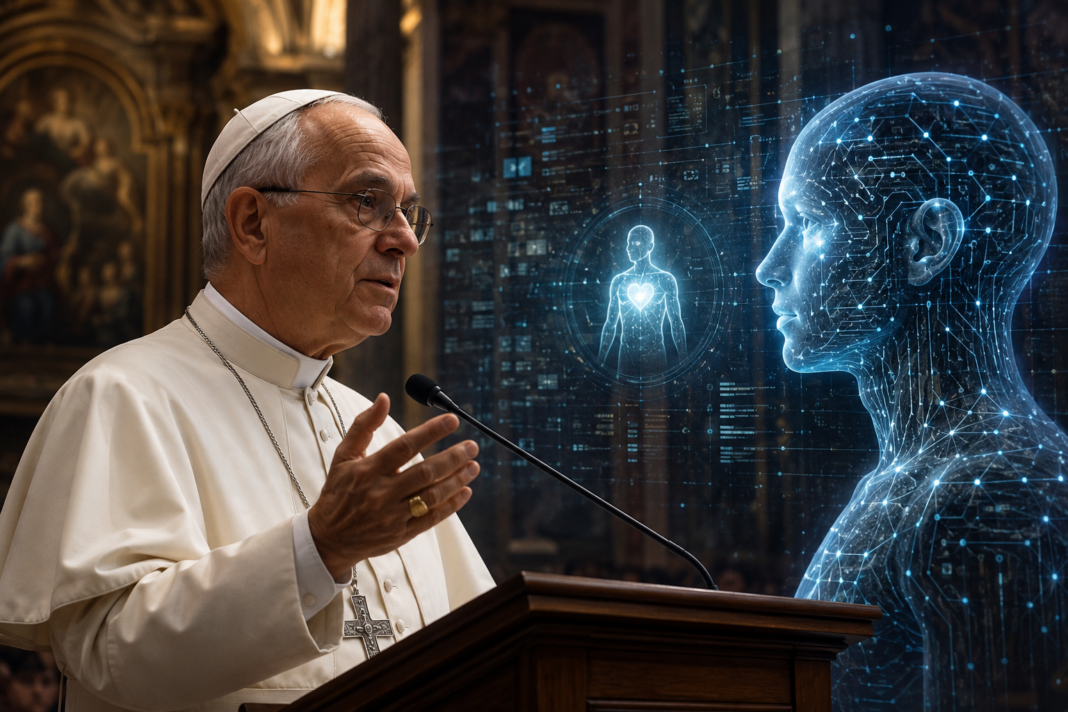

In a powerful new warning, Pope Leo says the future of artificial intelligence may depend on whether humanity remembers the value of the human soul.
The warning is two thousand years old.
“Be sober-minded; be watchful. Your adversary the devil prowls around like a roaring lion, seeking someone to devour.”
Peter wrote those words to a scattered, persecuted church living under the weight of an empire that had more power than they did, more reach than they could counter, and more influence over daily life than any individual believer could fully comprehend.
Last week, Pope Leo XIV wrote two words to a civilization living under the weight of technology that is moving faster than our moral frameworks can track, reshaping employment, healthcare, warfare, and human identity in ways no individual can fully comprehend.
Stay awake.
The centuries collapse. The warning is the same. The wall is just thinner in different places now.
What the Pope Actually Said — And Why It Belongs to Everyone
The Vatican’s new encyclical, Magnifica Humanitas, is not a document written only for Catholics. It is a moral intervention into a conversation that everyone is already living inside, whether they realize it or not.
Pope Leo invoked his predecessor Leo XIII, whose 1891 encyclical Rerum Novarum addressed the exploitation of workers during the Industrial Revolution — a moment when technology was reshaping human labor faster than human dignity could be protected.
He said plainly: we are in that moment again. Except this time, the stakes are higher.
The specific warnings are worth sitting with:
- Autonomous weapons systems operating beyond meaningful human control — machines making lethal decisions without a human conscience in the loop.
- Biased algorithms quietly blocking access to healthcare, employment, and security for the most vulnerable populations — not through dramatic assault but through the accumulated weight of a thousand small exclusions.
- The erosion of moral judgment — the gradual surrender of human discernment to systems that are faster, more efficient, and entirely without a soul.
“Today we find ourselves facing a transformation of similar magnitude,” the Pope said, “with perhaps even greater consequences.”
He compared AI governance to nuclear arms control. Not because AI is a bomb. But because unchecked, ungoverned power — regardless of the form it takes — has a consistent historical pattern.
It finds the thinnest moment in the wall.
The Theology Underneath the Technology
Here is what the encyclical is really arguing, underneath the policy language and the diplomatic framing:
Evil is not creative. It is opportunistic.
Artificial intelligence is not evil. The algorithm is not the lion. The technology itself — like nuclear energy, like the printing press, like every transformative tool humanity has ever developed — is morally neutral in its construction.
But power without conscience is not neutral in its application.
The lion does not build the thin place. It finds it. And right now, in the rapid, largely ungoverned, profit-driven expansion of AI systems into every corner of human life, there are thin places everywhere.
- The elderly person whose healthcare claim is denied by an algorithm that cannot account for the complexity of their specific situation.
- The job applicant whose resume never reaches a human eye because a screening system filtered them out based on data patterns that encode historical bias.
- The soldier in a future conflict whose fate is decided by a targeting system operating faster than any human override can function.
These are not science fiction scenarios. They are present-tense realities or near-term certainties. And none of them require a malevolent actor. They only require the absence of moral attention.
That is the thin place. Not the technology. The inattention.
“Stay awake,” the Pope said.
Peter said it first. “Be watchful.”
The instruction is the same because the vulnerability is the same. Human beings, in every era, have a consistent tendency to be lulled by comfort, efficiency, and progress into a drowsiness that leaves the wall unattended.
And the lion is always patient.
What a Machine Cannot Replace
The most theologically significant line in the entire encyclical is not about weapons or algorithms or governance frameworks.
It is this:
“The person bears within him- or herself a freedom, an interiority and a vocation to love and worship that no machine can replace.”
That is the Imago Dei argument stated in the language of the present moment.
Genesis 1:27 says human beings are made in the image of God. Not in the image of efficiency. Not in the image of optimization. Not in the image of pattern recognition or data processing or output generation.
In the image of God.
Which means there is something in a human being — the freedom, the interiority, the capacity for love and worship and moral anguish and genuine sacrifice — that is not replicable. Not because the technology is not sophisticated enough yet. But because what it would need to replicate is not a function. It is a nature.
You cannot train a model on the data of a soldier choosing to go through the door for someone else and produce the thing that made them do it. You can describe the behavior. You cannot reproduce the love.
You cannot build an algorithm that genuinely grieves. That sits with a father in the dark hours of a hospital waiting room and bears the weight of not knowing. That prays not because it was programmed to but because it is desperate and has nowhere else to turn.
The machine can imitate the words. It cannot carry the weight.
And this is precisely why the Pope’s warning matters beyond policy. Because a civilization that forgets the distinction — that begins to treat the imitation as sufficient, the efficiency as adequate, the output as equivalent to the person — is a civilization that has thinned its own wall from the inside.
Not through dramatic failure. Through gradual, comfortable, convenient forgetting.
What “Staying Awake” Looks Like for the Rest of Us
The Pope is speaking to governments and institutions and technology companies. That conversation needs to happen at that level, and it needs to happen urgently.
But most of us reading this are not policymakers. We are not AI executives or military strategists or international regulators.
We are people living inside the technology. Using it daily. Shaped by it in ways we are only beginning to understand.
So what does stay awake mean at the ground level?
- It means asking the question the algorithm never asks: Is this person being seen as a person?
- It means noticing when efficiency has quietly replaced relationship in your own life. When the text replaced the call. When the curated feed replaced the honest conversation. When the performance of connection replaced the vulnerability of actual presence.
- It means being suspicious of any system — technological, institutional, or personal — that promises to remove the difficulty of being human. Because the difficulty of being human is not a design flaw. It is where the image of God lives. In the freedom, the interiority, the vocation to love even when love is costly.
It means tending your own wall. Staying awake to the thin places — not just in society but in yourself. The places where you have been letting the machine think for you, decide for you, feel for you, so gradually that you almost did not notice the wall getting thinner.
“Resist him, standing firm in the faith, because you know that the family of believers throughout the world is undergoing the same kind of sufferings.” — 1 Peter 5:9
You are not the only one navigating this. The whole world is navigating this. And the instruction is not panic. It is not technophobia. It is not retreat.
It is resistance. Grounded, clear-eyed, faith-anchored resistance.
Standing firm. Staying awake. Tending the wall.
The Lion and the Algorithm
The lion does not announce itself. It prowls. It circles. It is patient in a way that should unsettle us because patience in a predator is not virtue — it is strategy.
The algorithm does not announce itself either. It optimizes. It personalizes. It learns your patterns and serves you what keeps you engaged, what keeps you scrolling, what keeps you inside the system — and it does this with a patience and precision that no human manipulator could match.
Neither one is creative. Both are opportunistic.
Both are looking for the thinnest moment in the wall.
The Pope’s two words are not a technological argument. They are a spiritual one. They are the ancient instruction of a shepherd apostle, carried forward across two millennia and placed into the hands of a civilization standing at the edge of something it does not fully understand.
Stay awake.
Not in fear. In faith.
Not in paralysis. In presence.
Not because the technology is the enemy. But because the image of God in you is worth defending — from every force, in every era, that would reduce you to a data point, a demographic, a function, a pattern.
You are not a pattern. You are a person.
Made in the image of the One who calls you by name.
Stay awake.
1 Peter 5:8-9 | Genesis 1:27 | Isaiah 43:1 | Nehemiah 6:3
“Be sober-minded; be watchful. Your adversary the devil prowls around like a roaring lion, seeking someone to devour. Resist him, standing firm in the faith.”
FaithSignal | Daily devotionals for people building a life of faith, purpose, and clarity.
Share this with someone who needs to know they are more than a pattern today.