



The idea of living forever isn’t new. People have been chasing it for as long as people have existed.
Religion promises eternity. Philosophers have wrestled with mortality for centuries. Musicians sing about living forever all the time. Billy Joe Shaver did it. Oasis did it. Drew Holcomb did it. Usually, though, nobody means it literally. Living forever tends to be shorthand for leaving a legacy, being remembered, loving deeply, making something that outlasts you.
Then there’s Bryan Johnson.
Bryan isn’t singing about immortality. He schedules it.
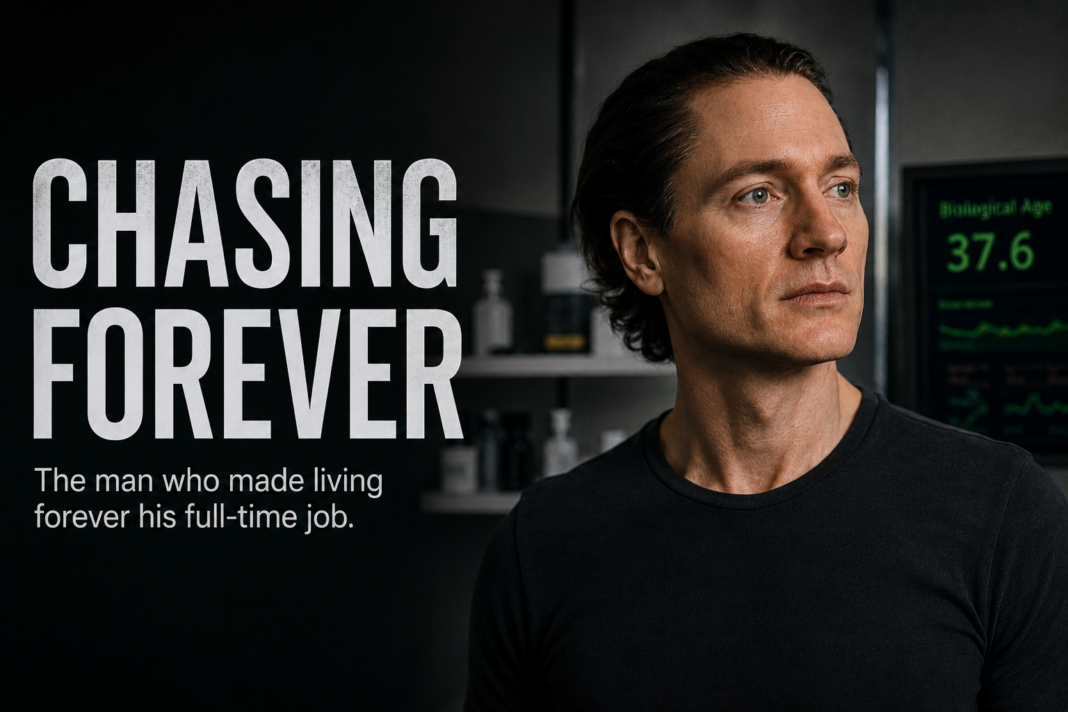
I recently watched a documentary following Johnson, the tech entrepreneur who has turned anti-aging into a full-time occupation. After building and selling a wildly successful business, he redirected much of his life toward a single goal: slowing the aging process as much as humanly possible.
His daily routine looks less like normal life and more like a clinical trial. Every meal is measured. Every biological marker is tracked. Sleep is optimized. Supplements are calculated. Blood work is constant. Entire teams of experts monitor his health.
And according to the numbers, it’s working.
His resting heart rate is exceptional. His body-fat percentage is elite. Various biomarkers suggest a biological age significantly younger than the number on his driver’s license.
Whether someone finds the project inspiring or bizarre, one thing is hard to deny: Bryan Johnson has managed to do something very few people have ever attempted at this scale. He has made longevity the organizing principle of his existence.
But what struck me most in the documentary wasn’t the science.
It was a single sentence.
“I have found more relief in demoting my mind and elevating my body,” Johnson explained. “It feels so liberating to me. Because my entire life, I was desperate to be free from myself.”
That statement stopped me cold.
Not because it sounded scientific.
Because it sounded deeply personal.
Behind all the blood tests and algorithms sits a much older human problem.
What exactly is the self that Bryan is trying to escape?
Johnson has spoken openly about years of depression, poor sleep, unhealthy habits, and periods where life felt unbearable. Long before he became the face of extreme longevity, he was fighting a battle many people understand all too well: the exhausting experience of living inside your own head.
His solution was unusual.
Most people try to use their minds to control their bodies. The ambitious executive ignores exhaustion to work longer hours. The athlete pushes through pain. The student sacrifices sleep for achievement.
Bryan went the opposite direction.
He decided his mind was the unreliable part of the equation.
The cravings couldn’t be trusted. The impulses couldn’t be trusted. The emotions couldn’t be trusted. So he handed authority to biological data instead.
His body became the decision-maker.
If the metrics said sleep, he slept.
If the metrics said eat, he ate.
If the metrics said stop, he stopped.
The fascinating thing is that many of us already understand the logic.
Most people have experienced the strange disconnect between knowing what is good for them and doing the opposite anyway. We know fast food isn’t healthy. We know endless scrolling drains us. We know certain habits make life worse.
And yet we continue.
Johnson’s project can almost be understood as an attempt to eliminate that internal conflict altogether. Instead of negotiating with himself, he built a system where biology gets the final vote.
But watching the documentary, I couldn’t shake the feeling that something was missing.
Near the end, Johnson reconnects with his son before his son leaves for college. The scenes are surprisingly moving. For a brief moment, the documentary shifts away from biomarkers and mortality toward something much harder to measure.
Relationship.
Connection.
Love.
The irony is impossible to miss.
For someone obsessed with extending life, some of the most meaningful moments shown on screen had nothing to do with extending life at all.
They came from sharing it.
And that’s where the story becomes larger than Bryan Johnson.
His experiment raises a question every person eventually has to answer. If perfect health became possible, what would it actually be for?
Living longer is not the same thing as knowing why you’re living.
A lower biological age cannot answer questions about purpose. A perfect sleep score cannot create meaning. No amount of optimization can tell someone what makes a life worth extending in the first place.
That’s the tension sitting underneath Johnson’s entire project.
The documentary presents a man attempting to conquer death through discipline, technology, and data. Yet some of the moments that seem to matter most arrive from sources that can’t be quantified on a spreadsheet.
The pursuit itself becomes fascinating because it exposes a truth most people already sense: human beings are more than biology.
We have bodies that require care. We have minds that require discipline. But neither one seems fully capable of carrying the weight of ultimate meaning by itself.
Bryan Johnson may be one of the most extreme examples of our age’s obsession with longevity. Yet beneath the supplements, scans, and statistics lies a question far older than modern science:
What does it actually mean to live well?
That’s a much harder question than how to live longer. And unlike aging, it’s one that can’t be solved in a laboratory.