


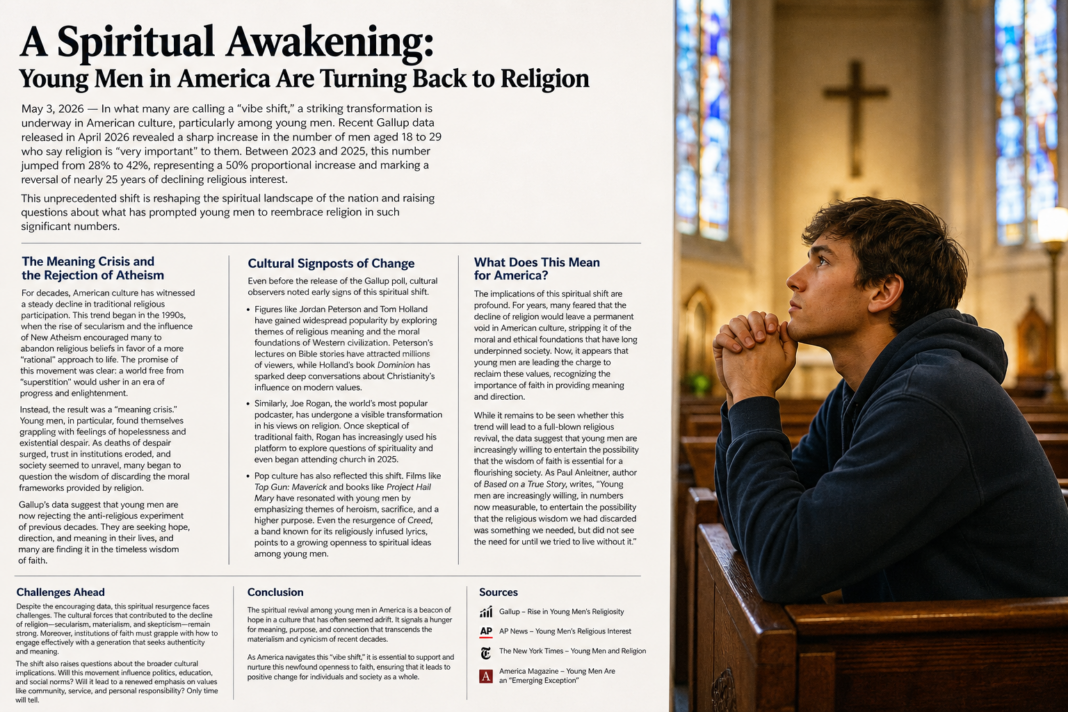

For twenty-five years, the cultural consensus was settled.
Religion was declining. Faith was fading. The smart money was on secularism — a clean, rational, progressive future where science replaced scripture and meaning was something you constructed for yourself out of whatever felt right on a given Tuesday.
The experiment is in.
The results are not what anyone expected.
A Gallup survey released in April 2026 revealed something that would have been unthinkable a decade ago: young men in America are turning back to God — and they’re doing it fast. Between 2023 and 2025, the percentage of men aged 18 to 29 who say religion is “very important” to them jumped from 28% to 42%.
That’s not a rounding error.
That’s a 50% proportional increase in two years. That’s a generation that was handed a world without God, looked around at what that world produced — and quietly started looking for something better.
Here’s what the data is actually telling us:
The generation that inherited the New Atheism experiment didn’t reject faith because they thought it through and found it wanting.
They rejected it because the culture told them to.
And now — after the deaths of despair, after the collapse of institutional trust, after the loneliness epidemic, after the meaning crisis settled into the bones of an entire generation like a cold that never quite went away — they are coming back.
Not because someone forced them.
Because they tried living without it.
And it didn’t work.
The Promise Was Simple
Strip away the “superstition.” Discard the moral frameworks built over two thousand years of human civilization. Replace them with science, progress, and the radical freedom to define your own truth.
What could go wrong?
As it turns out — quite a bit.
What filled the void left by faith was not enlightenment. It was not progress. It was not a generation of rational, flourishing, self-actualized men living their best secular lives.
What filled the void was despair.
Suicide rates among young men climbed. Addiction surged. Loneliness became a public health crisis. Men stopped showing up — to work, to relationships, to community, to purpose. The phrase “deaths of despair” entered the cultural vocabulary and refused to leave.
And somewhere in the middle of all of that wreckage, a generation of young men started asking a question that the secular framework had no answer for:
What am I actually here for?
The Meaning Crisis Nobody Wanted to Name
Philosophers have a term for what happens when a culture strips away its transcendent framework and replaces it with nothing: a meaning crisis.
It’s not a new concept. Nietzsche saw it coming in the 19th century when he wrote that the death of God would not be a liberation — it would be a catastrophe. That without a transcendent anchor, human beings would not flourish in their freedom. They would drift. They would grasp. They would fill the void with increasingly desperate substitutes.
He was right.
And young men — who have always been particularly susceptible to the need for a mission, a code, a cause worth dying for — felt it first and felt it hardest.
The meaning crisis didn’t announce itself. It arrived quietly, in the form of young men with no direction, no community, no framework for understanding suffering, no language for hope.
And then something unexpected happened.
They started finding their way back.
The Cultural Signposts Were There Before the Data
Before Gallup confirmed it with numbers, the culture was already showing the signs.
Jordan Peterson — a clinical psychologist who began lecturing on the psychological significance of Biblical stories — built one of the largest audiences on the internet almost entirely out of young men who had never been given a serious engagement with the wisdom tradition of Western civilization. They weren’t coming for religion. They were coming for meaning. And they found that the two things were harder to separate than they’d been told.
Tom Holland, a secular historian, spent years studying the ancient world and emerged with a conclusion that surprised even him: the moral framework that modern secular people take for granted — human dignity, care for the weak, the idea that every person has inherent worth — is not a product of the Enlightenment. It is a product of Christianity. His book Dominion didn’t just spark conversation. It forced a reckoning.
Joe Rogan — the most listened-to voice in American media — once approached religion with the casual skepticism of his generation. By 2025 he was attending church. Not performing it. Not announcing it as a brand pivot. Just quietly showing up.
Pop culture followed. Top Gun: Maverick — a film soaked in themes of sacrifice, honor, and something worth dying for — became one of the highest-grossing films in history. Young men didn’t just watch it. They felt something watching it. Something they hadn’t felt in a long time.
The data didn’t create the trend.
The data just finally caught up to what was already happening in living rooms, on podcasts, in late-night conversations between young men trying to figure out what they were supposed to be.
What This Means
Paul Anleitner, author of Based on a True Story, put it precisely:
“Young men are increasingly willing, in numbers now measurable, to entertain the possibility that the religious wisdom we had discarded was something we needed, but did not see the need for until we tried to live without it.”
Read that again.
We did not see the need for it until we tried to live without it.
That is not a defeat. That is not a regression. That is not a generation failing to keep up with progress.
That is wisdom — the hard-won, expensive kind that only comes from actually running the experiment and being honest about the results.
The Challenges Are Real
This movement is real. But it is not guaranteed.
The forces that drove the decline of faith — secularism, materialism, the cultural machinery that treats religion as something for the uneducated and the afraid — those forces are still operating. They haven’t conceded anything.
And the institutions of faith have their own work to do. A generation that is returning to God is returning hungry for authenticity. They have a finely tuned radar for performance, for institutional self-protection, for the gap between what a church says it believes and how it actually treats people.
They will not stay for a show.
They will stay for something real.
The question for every church, every pastor, every faith community watching this moment unfold is not “How do we market ourselves to young men?”
The question is: “Are we actually being what we claim to be?”
Because this generation will find out. And they will not be quiet about it.
The Bigger Picture
Here is what I believe is actually happening beneath the data:
God does not lose generations.
He allows them to wander far enough to understand what they left. He lets the hunger build until the noise of the alternatives can no longer drown it out. And then — quietly, without a press release, without a cultural announcement — He begins drawing people home.
“I will arise and go to my father.” — Luke 15:18
The prodigal son didn’t come home because someone convinced him with an argument. He came home because he had tried everything else and found it empty. He came home because the hunger finally became louder than the pride.
That is what is happening in America right now.
A generation is arising.
And they are going home.
DAILY DEVOTIONAL
The Generation That Came Home
Luke 15:17-18 — “When he came to his senses, he said, ‘How many of my father’s hired servants have food to spare, and here I am starving to death! I will arise and go to my father.'”
The prodigal son didn’t come home because of a sermon.
He didn’t come home because someone made a compelling intellectual argument for the existence of God. He didn’t come home because the culture shifted or the data changed or a podcast convinced him.
He came home because he was hungry.
Not metaphorically hungry. Actually, physically, desperately hungry — sitting in a field feeding pigs, watching them eat, and realizing that the life he had chosen in his freedom was killing him.
He came to his senses.
That phrase is worth sitting with today.
Not “he was convinced.” Not “he was corrected.” Not “he was shamed into returning.”
He came to his senses.
As if the truth had always been there — waiting, patient, unchanged — and all that was required was for the noise to get quiet enough for him to hear it again.
That is what is happening in America right now.
A generation of young men who were handed a world without God — who were told that faith was a crutch, that religion was superstition, that the rational path was the secular one — are coming to their senses.
Not because they were forced.
Because they tried the alternative.
And in the quiet, honest moments — the ones that come at 2am when the distractions stop working — they found themselves starving.
Here is what I want you to hold onto today:
The Father in that story did not wait for his son to arrive at the door before he started moving.
“While he was still a long way off, his father saw him and was filled with compassion for him; he ran to his son.” — Luke 15:20
He ran.
Not walked. Not waited with arms crossed and a list of conditions. He ran — which means he had been watching the road. Which means every day his son was gone, the Father was looking toward the horizon, waiting for the moment the silhouette on the road would become the face he loved.
If you are praying for someone who has wandered —
A son. A daughter. A friend. A generation.
This is your scripture today.
The Father is still watching the road.
He has not stopped looking.
And the moment that person comes to their senses — the moment the hunger becomes louder than the pride — He will not wait for them to make it all the way home before He starts running.
Pray for this generation today.
Not with anxiety. Not with judgment. Not with the exhausted frustration of someone who has been waiting too long.
Pray with the posture of the Father —
Eyes on the horizon. Compassion already moving. Ready to run.
The data says they’re coming.
Scripture says He’s already headed toward them.
That’s not a coincidence. That’s a God who never stopped watching the road.
Father, I pray for the young men finding their way back to You today — the ones who don’t have the language for it yet, the ones who are just beginning to feel the hunger, the ones who are still a long way off. Run toward them. Meet them before they make it all the way home. And use Your people — Your church, Your community, Your body — to be the face of a Father who never stopped watching the road. Amen.
☕✝️🔥 Sunday morning. This one hits different today.