
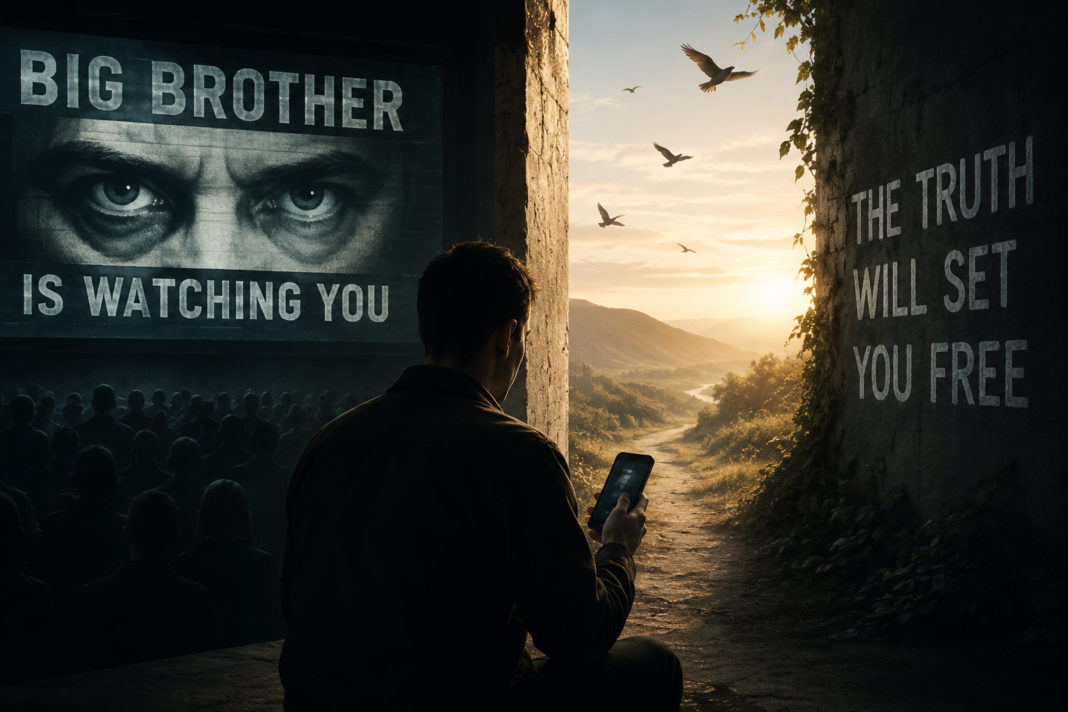

George Orwell titled his novel 1984 as a warning. The world Orwell warned about didn’t disappear. It just became digital, personalized, and impossible to put down.
He envisioned a world where truth was manufactured, language was weaponized, history was rewritten, and the most dangerous act a person could commit was to think independently.
Orwell wrote it in 1949, setting his dystopian vision in the not-so-distant future of 1984. When that year finally arrived, Christianity Today posed a question that echoed through the cultural moment:
Did Orwell’s nightmare come true?
The answer in 1984 was a cautious “Not yet. But watch carefully.”
Forty-two years later, the answer is no longer so simple.
📖 What Orwell Actually Understood
When Christianity Today reviewed 1984 in January of that year, the editor made an observation that has aged with startling clarity:
“Orwell’s understanding of good and evil are not far from Christian. According to 1984, the antidotes to political poison lie in truthful words and loving acts. Only his conclusion needs correction. He knew evil, he knew the good that evil wants to destroy. But he did not understand the strength that can endure and paradoxically conquer under the most savage victory of evil. To understand that, he would have needed to understand the Cross.”
Read that again. Slowly.
Orwell diagnosed the disease with stunning precision. Propaganda. Doublethink. The erasure of objective truth. The gradual transformation of free people into accomplices of their own oppression.
But Orwell couldn’t prescribe the cure.
Because he didn’t know the One who had already conquered the worst that evil could do.
The Cross remains the only answer to Big Brother that actually holds.
🔍 The 1984 Warning Nobody Took Seriously Enough
In that same year, Christianity Today published another piece, one that now reads more like prophecy than journalism.
Computer scientists, the article reported, were working on “artificial intelligences that will fundamentally and irrevocably change what we call human.”
The writer compared the state of AI to the auto industry in its infancy:
“Think of what the world was like 75 years ago in the auto industry. That is about where AI is today. Although the auto industry changed aspects of our lives, intelligent machines will change thought, reason, and imagination in a way that has never happened previously.”
And then came this chilling line:
“The union between man and an artificial intelligence creates a new Adam, a whole whose sum is greater than its parts. What we have is a creature not made by God in His image, but made by us in our image. It would be like our having the ability to surpass God — which, of course, is what we have been trying to acquire since the Garden of Eden.”
That was written in 1984.
Before the internet. Before smartphones. Before algorithms that know your fears better than your closest friends. Before AI could write sermons, compose songs, and simulate relationships — all before you’ve had your morning coffee.
The temptation of the Garden didn’t disappear.
It just got a better interface.
🔥 Where Orwell’s World Actually Lives Now
Big Brother didn’t arrive in a military uniform.
He arrived in a notification.
The tools Orwell described — rewriting history, manufactured consensus, punishing independent thought, twisting language until it means its opposite — these aren’t distant government tactics.
They’re the architecture of the platforms we scroll before we even get out of bed.
- Doublethink? Orwell described it as holding two contradictory beliefs and accepting both as true. Today, we call it the algorithm. It doesn’t care what you believe — only that you stay engaged. Outrage, fear, validation, entertainment. Truth is optional. Reaction is the product.
- The Ministry of Truth? Orwell imagined an institution that rewrote history to fit the narrative of the moment. Today, we call it content moderation policies. What gets amplified, suppressed, or labeled shapes reality for billions. A handful of people make those decisions, accountable to almost no one.
- Room 101? Orwell’s torture chamber used your worst fear to break your will. Today, the algorithm has already mapped your Room 101. It knows your fears, your insecurities, the things that make you pause. It doesn’t need to break you. It just needs to keep you scrolling.
Orwell wasn’t wrong.
He was just early.
✝️ What the Cross Has to Say About All of This
The Christianity Today editor in 1984 was right: Orwell understood the problem.
But the solution? That’s where he fell short.
The answer to Big Brother isn’t a better system, a smarter policy, or a new platform.
The answer is a Person.
Jesus didn’t build a propaganda machine. He spoke truth plainly, in public, to people who had the power to kill Him for it — and did.
He didn’t optimize His message for the crowd. He didn’t soften His words to improve engagement. He didn’t rewrite history. He fulfilled it.
And when the full force of empire, religion, and human evil converged on a hill outside Jerusalem to silence Him forever —
He walked out of the grave three days later.
The only answer to Big Brother that works is not resistance. Not revolution. Not a better algorithm.
It’s resurrection.
💡 What This Means for How We Live Right Now
Francis Schaeffer once said that Christianity is not just personally true. It’s publicly true.
It’s the only framework that can make sense of human dignity, objective truth, and the nature of evil.
That’s what the world needs now. Not Christians who are digitally savvy.
Christians who are truth-anchored.
- People who know the difference between information and wisdom.
- People who can separate engagement from discipleship.
- People who see through the algorithm’s version of reality to the one spoken into existence by God Himself.
Practically, that looks like this:
- Read slowly. The algorithm rewards reaction. Wisdom requires reflection.
- Speak carefully. Orwell’s world is built on language abuse. Christians are called to let their yes be yes and their no be no.
- Build real community. Big Brother can’t surveil what isn’t online. The dinner table, the small group, the face-to-face conversation — these are acts of resistance.
- Anchor in Scripture daily. Not as a ritual. As a recalibration. The only counter-narrative to the algorithm is the Word of God.
- Remember the Cross. Every time the world tells you power wins, truth is relative, or the loudest voice prevails — remember what happened on Good Friday. And what happened three days later.
📋 The Question 1984 Is Still Asking
Orwell ended his novel with a man broken, fully converted to the system, loving the very thing that destroyed him.
That ending wasn’t a prediction. It was a warning.
And the question 1984 is still asking in 2026 is the same one it asked in 1984:
Will you think for yourself — or let the system think for you?
For Christians, the answer has always been clear.
We already have a Mind to submit to.
We already have a Truth that doesn’t shift with the news cycle.
We already have a narrative that began before time and ends in the restoration of all things.
Big Brother can’t compete with that.
He never could.
“You will know the truth, and the truth will set you free.”
— John 8:32
FaithSignal | Faith, culture, and clarity for people building a life that lasts.
Share this with someone who needs to see the difference between noise and truth.