

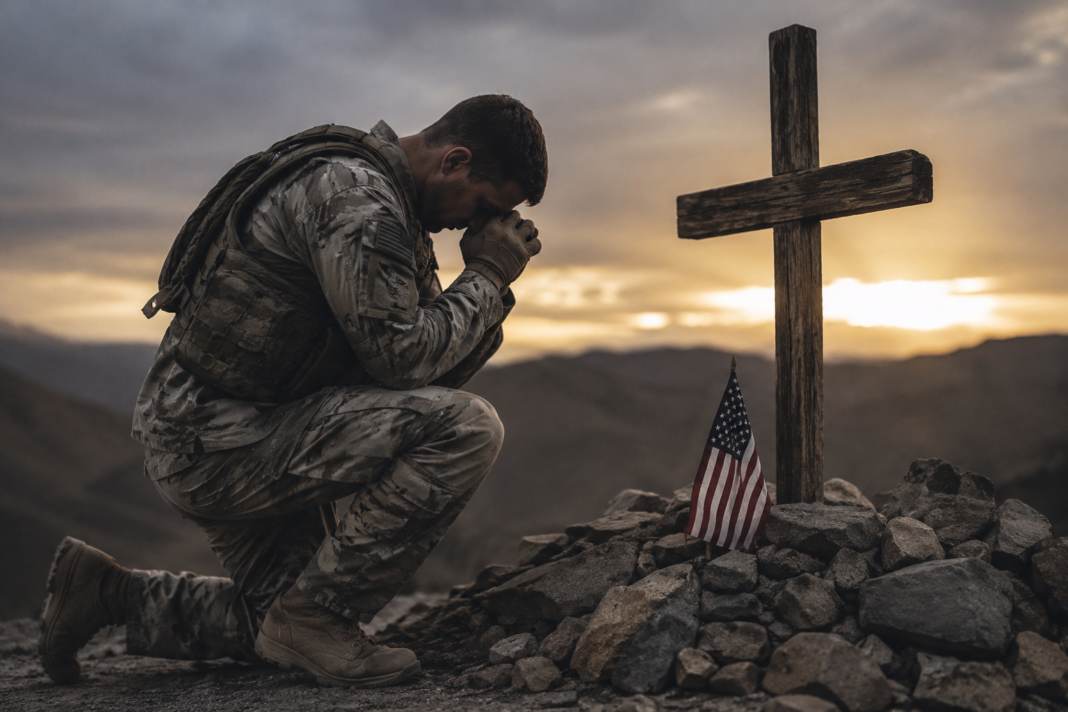

What a Soldier’s Faith Looks Like
The Theology of Courage — And What It Says to the Rest of Us
There is a moment every combat veteran describes differently but means the same thing.
It is the moment before.
Before the door opens. Before the ramp drops. Before the order comes.
The moment when the mind has run through every possible outcome, and the body has not yet moved. The moment when a human being — someone’s son, someone’s father, someone’s husband — makes a decision that no amount of training can fully prepare you for.
They go anyway.
Not because they are fearless. The ones who have been there will tell you plainly: fear is always present.
But alongside the fear, there is something stronger. Something that gets a person to their feet and through the door when every instinct says, stay down.
Theologians have a word for it. So do soldiers. They just use different language.
They call it faith.
The Courage That Looks Like Ordinary People
If you’ve ever read Medal of Honor citations — those military documents that describe acts of extraordinary valor — one detail stands out.
The people in them sound so ordinary.
A 19-year-old from rural Ohio.
A father of two from South Carolina.
A kid who wanted to be a mechanic.
A former high school baseball player from New Mexico.
They are not described as fearless. They are not described as superhuman.
They are described as people who, in a specific moment of crisis, chose someone else over themselves.
That is not just a military phenomenon. That is a theological one.
It is the same impulse that drove a shepherd boy named David toward a giant when every rational calculation said to retreat.
The same impulse that kept Paul writing letters from prison when despair would have been easier.
The same impulse that walked Jesus toward Jerusalem, knowing exactly what waited there.
“Greater love has no one than this: to lay down one’s life for one’s friends.” — John 15:13
The soldier in the citation didn’t quote that verse. But he lived it. In the mud, in the dark, in the moment before — he lived it completely.
Faith Under Fire — What It Actually Requires
There is a version of faith that is comfortable.
It lives in Sunday mornings, quiet devotionals, and the peaceful certainty of a life where the stakes are manageable.
And then there is the faith that gets tested in the places where comfortable faith cannot survive.
Military chaplains — the men and women who sit with soldiers before combat and after loss — describe a pattern.
The faith that holds under fire is not the faith that has never been questioned. It’s the faith that has been questioned, broken, rebuilt, and questioned again until what remains is not certainty, but something more durable.
Trust.
Not I know how this ends. But I trust the One who does.
That distinction matters.
Because the soldier going through the door does not know how it ends.
The parent sitting in a hospital waiting room does not know how it ends.
The person carrying a weight so heavy they’re not sure they can keep moving does not know how it ends.
What they have — what sustains them — is not information. It is orientation.
A decision, made in advance of the outcome, to keep moving in the direction of what they believe is right and true and worth the cost.
That is faith under fire. That is the theology of courage.
What It Says to the Rest of Us
Most of us will never face what a soldier faces. The door will not be that door. The stakes will not be those stakes.
But we all know the moment before.
The moment before the hard conversation.
The moment before the doctor walks in with the results.
The moment before the decision that changes everything.
The moment before you choose to keep going when everything in you wants to stop.
The soldier’s faith does not belong only to soldiers.
It belongs to every human being who has ever had to move forward without guarantees.
What the fallen teach us — what their lives and deaths inscribe into history — is that it is possible.
That a human being can face the worst possible outcome and still choose love over self-preservation.
That courage is not the absence of fear but the decision that something matters more than fear.
That faith is not a feeling. It is a direction.
And that direction — toward others, toward sacrifice, toward something bigger than yourself — is the most fully human thing we can do.
The Faith That Survives the Foxhole
There’s a reason the phrase “there are no atheists in foxholes” has lasted for generations.
Not because it is literally true — it’s not — but because it points to something real.
Extremity clarifies.
When everything nonessential has been stripped away by fear and exhaustion and the proximity of death, what remains is the irreducible question that every human being eventually faces:
Is there something worth dying for?
The men and women we honor today answered that question with their lives.
They decided — in the moment before, in the mud, in the dark — that yes. There is.
You are. Your children are. This country, this idea, this fragile, imperfect, worth-defending experiment in human freedom is.
That answer didn’t require a theology degree. It didn’t require perfect certainty or the resolution of every doubt.
It required only the willingness to act on what they believed when the cost of believing became total.
That is the most honest faith there is.
And on this Memorial Day, it is worth sitting with — not just in gratitude for what they gave, but in honest examination of what we are doing with the faith we claim to carry.
They went through the door.
What door are we standing in front of?
John 15:13 | Psalm 23:4 | Joshua 1:9
“Have I not commanded you? Be strong and courageous. Do not be afraid; do not be discouraged, for the Lord your God will be with you wherever you go.”
FaithSignal | Daily devotionals for people building a life of faith, purpose, and clarity.
Share this with someone who needs to be reminded of what courage looks like today.