


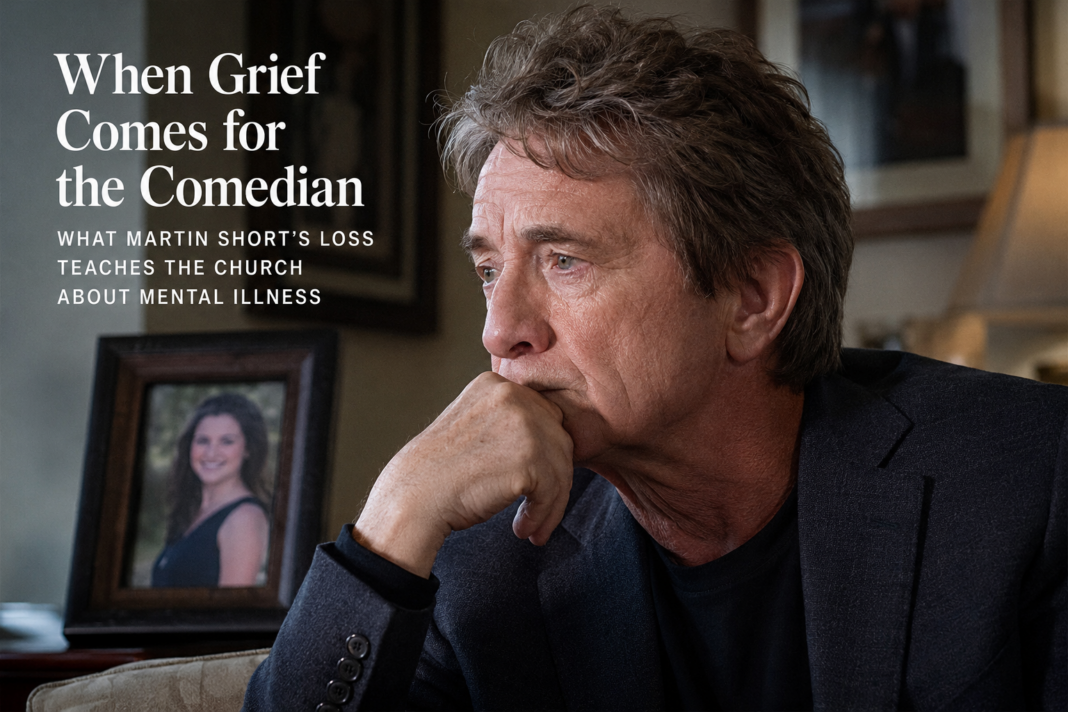

What Martin Short Said About Suicide Stopped Me Cold
He has spent half a century making the world laugh. But behind the curtain of one of Hollywood’s most cherished careers lies a story of grief so profound it would have shattered most people. This week, Martin Short shared that story, and what he said deserves the Church’s undivided attention.
On Sunday morning, May 10, Martin Short sat down for an interview on CBS Sunday Morning. For the first time, he spoke publicly about a loss so deep it defies comprehension.
His daughter Katherine — 42 years old, a licensed clinical social worker, a mental health advocate who dedicated her life to helping others heal — died by suicide at her home in Hollywood Hills on February 23.
“It’s been a nightmare for the family,” Short said, his voice steady in the way only someone who has learned to carry grief can manage.
But it was what he said next that should stop every pastor, small group leader, and believer in their tracks:
“Mental health and cancer, like my wife’s, are both diseases, and sometimes with diseases they are terminal. And my daughter fought for a long time with extreme mental health — borderline personality disorder, other things — and did the best she could until she couldn’t.”
Read that again. Slowly.
A father, in public, refusing to let shame be the last word about his daughter’s life.
Who Katherine Short Was
Katherine Hartley Short was the eldest of three children Martin adopted with his late wife Nancy Dolman, who herself passed away from ovarian cancer in 2010 at the age of 58. Katherine is survived by her two younger brothers, Oliver and Henry.
Katherine lived a life largely out of the public eye, but the details of her story are striking.
She earned a bachelor’s degree in psychology and gender/sexuality studies from New York University in 2006, followed by a master’s degree in social work from the University of Southern California in 2010 — the same year she lost her mother.
She went on to work as a licensed clinical social worker in private practice in Los Angeles, as well as part-time at Amae Health, a clinic focused on community outreach, family support, and psychotherapy. She also worked with Bring Change to Mind, a nonprofit dedicated to dismantling the stigma surrounding mental illness.
Let that sink in: a woman who battled mental illness every day of her adult life chose to spend that life walking into the darkness with others who were fighting the same battle. She didn’t run from it. She leaned into it. She held a light for others even as she fought to keep her own lit.
That’s not a footnote. That’s a testimony.
The Disease We Still Don’t Talk About
On Sunday, Martin Short used a word that the Church has often struggled to say without flinching: suicide.
And he said it with purpose.
“Not hiding from the word suicide, but accepting that this can be the last stage of an illness,” he told CBS. His voice was clear, his conviction unwavering. He spoke of taking “mental health out of the shadows” so people wouldn’t feel ashamed to talk about it.
This is where the Church must lean in, not look away.
The American Psychiatric Association once surveyed over 2,000 American adults and found that 60% of people said their faith or spirituality played a critical role in their mental wellness. And yet, only 52% said their religious communities openly discuss mental health without stigma.
That gap is not just a statistic. It’s a person — someone sitting quietly in your congregation, battling a storm they believe they can’t name out loud.
Research published in Psychiatric Services found that faith communities are becoming increasingly recognized as vital partners in mental health care. Nearly one in four adults experiencing a mental health crisis seeks help first from clergy.
Even more striking, 68% of people of faith said they’d be more likely to seek professional help if their pastor or faith leader encouraged it.
Sixty-eight percent.
That means what your pastor does or doesn’t say about mental illness isn’t just a spiritual issue. It’s a clinical one.
The Weight of Grief
Martin Short’s words carry weight because they don’t come from theory. They come from decades of personal experience.
By the time he was 20 years old, Martin Short had buried his brother David, his mother Olive, and his father Charles.
David, the “star of the family,” died in a car accident in 1962. At David’s funeral, Olive was diagnosed with cancer. She passed away three years later. Charles died of a stroke the following year.
“I did have an understanding from my childhood that the end of life was going to happen to all of us, and for some, it’s too early,” Short said on CBS Sunday Morning. “We have to celebrate and be lucky enough for the experiences that we’ve had with them.”
And then he said something that stopped me in my tracks:
“Just to think of them — they’ve just gone into the next room for a while.”
He may not have intended it as theology. But it is.
It echoes Paul’s words in 1 Thessalonians 4:13: “Do not grieve like the rest of mankind, who have no hope.” It echoes C.S. Lewis’ imagery in The Last Battle — that death is not an ending but a doorway, and that the truest life begins on the other side of it.
A man who has spent a lifetime making people laugh has, in his grief, stumbled onto the oldest comfort the Gospel offers: the people we love are not gone. They’ve simply gone ahead.
What the Church Must Do
Martin Short is not a pastor. He is not writing a theology of suffering. He’s a father who lost his daughter and is choosing — in public, at 76 years old, with a Netflix documentary on the horizon — to refuse shame as the legacy of her life.
The Church should do the same.
Here’s what that could look like:
| What the Church Can Do | Why It Matters |
|---|---|
| Name mental illness — by name — from the pulpit | 68% of people of faith will seek help if their faith leader recommends it. |
| Treat suicide as a medical death, not a moral failure | Shame silences the very people who need community the most. |
| Train small group leaders in mental health first aid | Nearly 1 in 4 people with mental illness turn to clergy before seeking care. |
| Partner with licensed Christian counselors | Faith + professional care produces measurably better outcomes. |
| Create space for grief that has no tidy resolution | Some losses aren’t solved. They’re carried. Community makes them bearable. |
Katherine Short spent her life doing this work. She walked into the darkness every day to help others find light. She did it while fighting her own battles. She did it until she couldn’t.
Her father is carrying her torch now, in the only way he knows how: by saying her name, speaking the word suicide without flinching, and insisting that her illness — like his wife’s cancer — was a disease, not a disgrace.
The Church must follow his lead.
If you or someone you know is struggling, contact the 988 Suicide and Crisis Lifeline by calling or texting 988 — available 24/7. You are not alone.
☕✝️🔥 Grief is not the absence of faith. It is the evidence of love. And love — even in the shadow of loss — is still the greatest of these.