


By: Jake Boals | Date: April 28, 2026
Quick Summary: 3 Key Points
- Federal Mandate for Driver Surveillance
Buried in the 2021 Infrastructure Bill, Section 24220 requires every new car to include driver monitoring technology — cameras, sensors, and algorithms — to detect impairment. The system can override the driver and contact authorities, even though NHTSA admits the technology is unreliable. - Privacy and Data Concerns
In-cabin cameras could record private moments and share footage with insurers, law enforcement, or other third parties. Automakers already sell driving behavior data, and this mandate could expand surveillance into personal spaces without clear legal protections. - Faith and Freedom at Risk
Christians should oppose this mandate as a violation of human dignity, presumption of innocence, and family privacy. Surveillance without consent undermines biblical principles of justice and the sanctity of private life. The Church must act before this rule is finalize
Read the Full Story
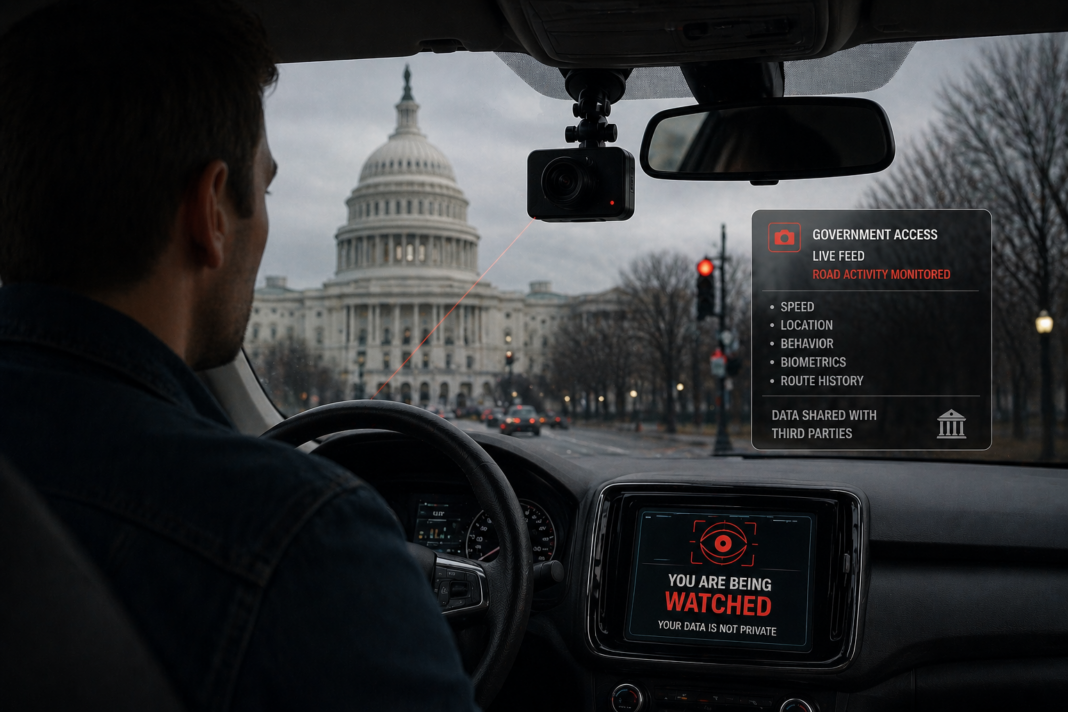
A surveillance mandate buried in a 2021 infrastructure bill could put a federal camera inside every new vehicle in America — watching your face, judging your behavior, and sharing the footage with people you never agreed to let in. The technology doesn’t work. The rule is still coming.
There is an old principle in Christian thought — rooted in natural law, affirmed by the Reformers, and enshrined in the American founding — that the home is a sanctuary. That private space deserves protection from the reach of the state. A man’s house is his castle not because of arrogance, but because God made human beings with dignity, and dignity requires a sphere of life that belongs to the individual and not to the government.
For most of American history, your car was part of that sphere.
That is about to change — quietly, bureaucratically, and with almost no public debate.
The Mandate Nobody Voted On
Buried inside the $1.2 trillion Infrastructure Investment and Jobs Act of 2021 — sold to the public as roads, bridges, and broadband — is Section 24220. It orders the federal government to require driver monitoring technology in every new passenger vehicle sold in America.
Not a seatbelt. Not an airbag. A system that:
- Watches the driver via cameras, sensors, and behavioral algorithms for signs of impairment — drowsiness, distraction, or intoxication.
- Judges the driver in real time, using software to decide whether you are fit to operate your own vehicle.
- Overrides the driver — slowing the car, pulling it over, or contacting emergency services — if the algorithm decides you are unfit.
The rule was supposed to be finalized by late 2024. It wasn’t. The National Highway Traffic Safety Administration (NHTSA) missed the deadline — and in a report delivered to Congress in March 2026, NHTSA’s own engineers admitted why: the technology isn’t ready.
Washington is preparing to mandate a surveillance system its own regulators say doesn’t work.
When the Technology Fails, You Pay the Price
The problems NHTSA flagged in its March 2026 report are not minor calibration issues. They are fundamental:
- False positives — A yawn, a long blink, adjusting the radio, or glancing at a passenger can trigger an “impaired” reading.
- Environmental failures — Sunglasses, low light, facial hair, headwear, and even skin tone have produced inconsistent results in testing.
- Reliability gaps — Breath-based and touch-based sensors have failed to deliver consistent accuracy in real-world conditions.
Picture this: you are driving your family home from church on a Sunday morning. You glance at your child in the back seat. The algorithm flags it. The car begins to slow on the interstate. Emergency services are called. You have done nothing wrong.
That is not a hypothetical. That is what the government’s own engineers are describing — and the mandate is still moving forward.
Your Insurance Company Is Already Watching
Here is the part the bill’s supporters do not lead with: once the car is watching you, that data does not stay in the car.
A 2024 New York Times investigation revealed that automakers including GM, Honda, Hyundai, and Kia were already quietly selling driving behavior data — hard braking, speeding, late-night trips — to data brokers like LexisNexis, who then sold it to insurers, who then raised premiums on drivers who never signed up for a monitoring program.
Drivers found out only when their rates went up.
Now layer a federally mandated in-cabin camera system on top of that existing pipeline. The questions that follow are not paranoid — they are practical:
- Who owns the footage of your face, your eyes, your children in the back seat?
- Can your insurer demand access as a condition of coverage?
- Can law enforcement subpoena it without a warrant?
- Can it be used against you in a divorce, a custody case, a civil suit?
The law does not answer any of those questions. Neither does the proposed rulemaking.
Why This Is a Faith Issue — Not Just a Political One
Christians should care about this for reasons that go deeper than politics.
First, it is a question of human dignity. The biblical vision of the human person is not a subject to be monitored, scored, and managed by an algorithm. Genesis 1:27 tells us that men and women are made in the imago Dei — the image of God. That image carries inherent worth that no government system can quantify and no data broker has the right to sell.
Second, it is a question of presumption of innocence. The traditional Fourth Amendment posture — which reflects a deeply Christian understanding of justice — says that surveillance requires cause. You are innocent until the state demonstrates otherwise. This mandate inverts that entirely. Every driver is monitored by default. The algorithm decides if you are cleared. That is not justice. That is suspicion as a baseline.
Third, it is a question of the family. When that camera is on, it is not just watching the driver. It is watching whoever is in the car — your spouse, your children, your pastor, your small group leader on the way to a retreat. The private conversations, the moments of prayer, the tears on the way home from a hard diagnosis. All of it, potentially recorded, potentially accessible, potentially sold.
Proverbs 22:3 says: “The prudent see danger and take refuge, but the simple keep going and pay the penalty.”
This is the moment to see the danger clearly.
Where the Mandate Stands Today
| Milestone | Status |
|---|---|
| IIJA signed into law | November 2021 |
| NHTSA Advance Notice of Rulemaking | January 2024 |
| Statutory deadline for final rule | Missed — late 2024 |
| NHTSA Report to Congress | March 2026 — technology not ready |
| Automaker compliance window | 2–3 years after final rule is issued |
| Projected real-world rollout | 2028–2030 |
The mandate is delayed. It is not repealed. Congress could pull it back. It hasn’t.
What Faithful Citizens Should Do
Nobody is defending drunk driving. Impaired driving kills roughly 13,000 Americans a year, and that is a genuine tragedy worth addressing. The question is whether the answer to that real problem is a surveillance system installed in the private vehicle of every sober American — built on technology that doesn’t work, with no guardrails on where the data goes.
Before a single new camera is legally required to point at an American driver, three things must be true — and right now, none of them are:
- Independent proof the technology works — validated by testing that is not self-certified by the industry selling it.
- Hard statutory limits on data sharing — no insurer, broker, or third party access without explicit, revocable consent.
- A warrant requirement — law enforcement cannot access in-cabin footage without going before a judge.
Until those three boxes are checked, this is not a safety rule. It is a surveillance rule wearing a seatbelt.
Pray. Stay informed. Contact your representatives. The final rule has not been issued. The window to act is still open. And the Church has always been at its best when it speaks clearly about the dignity of the people God made — before the algorithm gets to decide what that’s worth.
Sources
- NHTSA Report to Congress, March 2026 — Advanced Impaired Driving Prevention Technology
- Road & Track — “NHTSA to Congress: Advanced Impaired Driving Detection Technology Isn’t Ready”
- IIJA Section 24220 — Impaired Driving Prevention Technology Provision
- The New York Times, 2024 — Automaker data-sharing investigation
- Faith Signal — Tuesday, April 28, 2026